
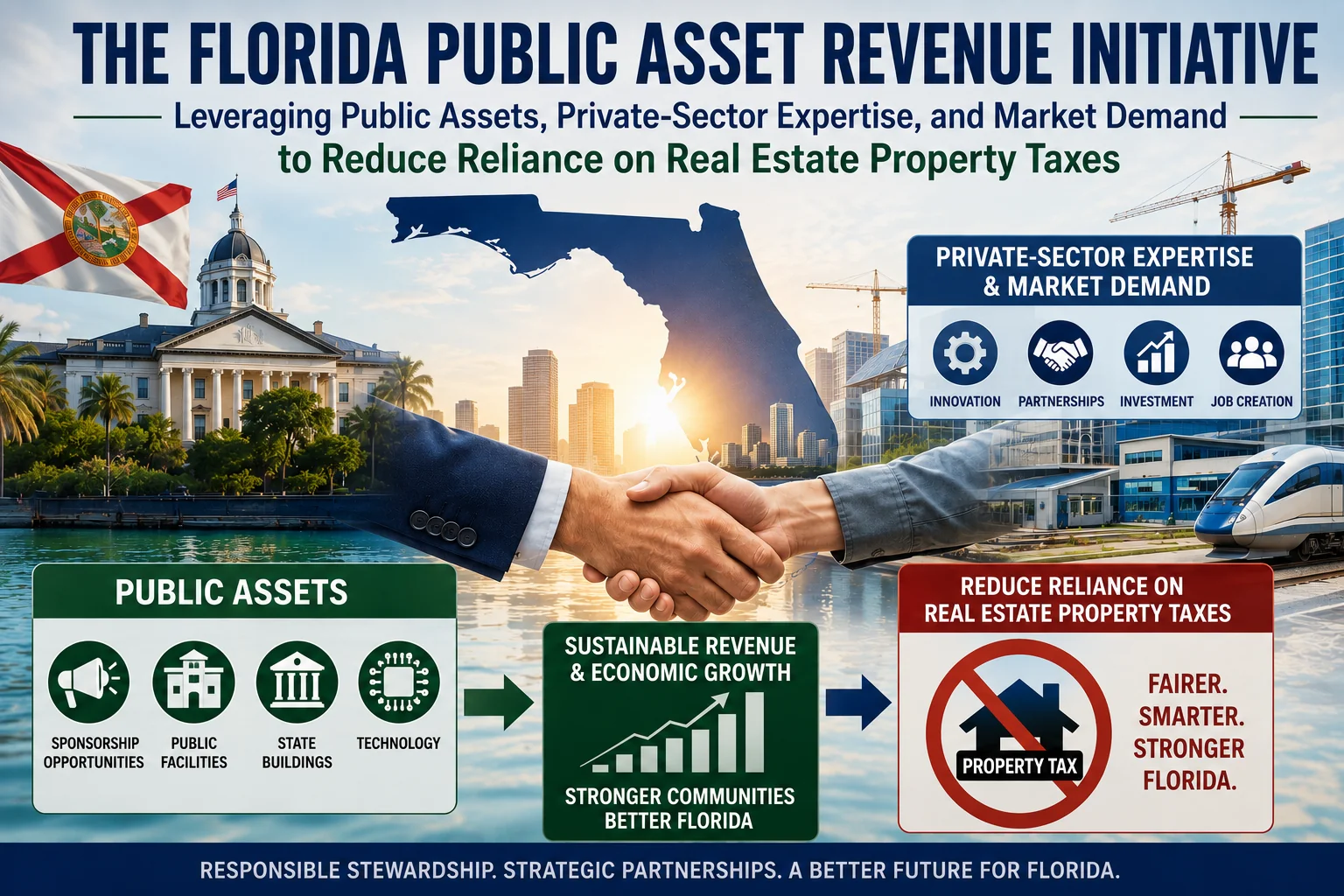
The Florida Public Asset Revenue Initiative
A New Approach to Reducing Reliance on Property Taxes
Florida’s growth has created both tremendous opportunities and significant financial pressures. Families are facing higher housing costs, insurance premiums, and property tax bills, while local governments must continue funding essential services and infrastructure.
The challenge is clear: How can Florida reduce its reliance on real estate property taxes without simply cutting essential public services or shifting the burden somewhere else?
One potential solution is to rethink how government uses the assets it already controls.
The Policy Issue: Too Much Reliance on Property Owners
Property taxes remain an important source of revenue for local governments, helping fund services such as public safety, infrastructure, and other community needs. But the traditional model places a recurring financial obligation on property owners year after year.
For homeowners—especially seniors on fixed incomes and families dealing with rapidly rising costs—this can create significant financial pressure. A person may own their home outright and still face an increasing annual tax obligation simply because the assessed value of the property has increased.
At the same time, Florida possesses an enormous portfolio of tangible and intangible public assets with economic value that may not always be used to their full revenue-generating potential.
The question should therefore be broader than simply asking whether government should raise taxes or cut spending.
We should also ask: Are we making the best possible use of the public assets Floridians already own?
The Solution: The Florida Public Asset Revenue Initiative
The Florida Public Asset Revenue Initiative would establish a framework for identifying appropriate public assets and creating responsible opportunities to generate new, non-tax revenue from them.
The concept is straightforward:
Leverage public assets, private-sector expertise, and existing market demand to create sustainable revenue that can reduce long-term reliance on real estate property taxes.
This is not about selling off public assets. It is not about government competing unnecessarily with private businesses. And it is not about using taxpayer purchasing power to subsidize private companies.
Instead, the initiative would identify areas where the state and participating public entities already possess something of legitimate market value and create carefully structured opportunities to generate revenue from it.
Four potential areas include:
-
- Sponsorship Opportunities: Creating responsible sponsorship and naming opportunities for appropriate public programs, facilities, events, or other assets while maintaining strict ethical and public-interest standards.
- Public Facilities: Making better use of eligible public spaces and facilities through leasing, concessions, events, partnerships, and other revenue-producing opportunities.
- State Buildings: Identifying underutilized spaces or appropriate commercial opportunities within state-owned properties without interfering with their public purpose.
- Technology: Developing responsible ways to generate value from government-created technology, digital infrastructure, licensing opportunities, and other innovations while maintaining strong privacy and cybersecurity protections.
Bringing Private-Sector Expertise Into the Equation
Government does not need to build every commercial strategy internally.
The private sector has expertise in marketing, technology, asset management, innovation, and identifying market demand. Through competitive and transparent partnerships, Florida could use that expertise to determine where legitimate revenue opportunities exist.
The public retains ownership and oversight. The private sector contributes specialized expertise. The market determines whether genuine demand exists.
The result can be a public-private revenue model designed to create value from assets that already exist.
Protecting the Public Interest
Any initiative of this size would require strong safeguards. Public assets belong to the people, and revenue generation should never override their intended public purpose.
The framework should include transparent competitive bidding, independent valuation, public reporting, conflict-of-interest protections, privacy safeguards, restrictions on inappropriate sponsorships, and clear requirements governing how new revenue is used.
Most importantly, the initiative should create a measurable connection between new non-tax revenue and property tax relief. Otherwise, there is a risk that new revenue simply becomes additional government spending.
A Different Way of Thinking About Government Revenue
For too long, many public finance debates have been limited to two choices: raise taxes or cut services.
There should be a third question:
Can we create more value from what the public already owns?
Florida has public facilities, buildings, technology, intellectual assets, infrastructure, and other resources with potential economic value. If even a portion of those assets can responsibly generate new revenue, those funds could help diversify public revenue and reduce pressure on property owners.
The Florida Public Asset Revenue Initiative represents a shift toward a more entrepreneurial model of public stewardship—one that treats public assets not simply as expenses to maintain, but as resources that may also create value for the people who own them.
Responsible stewardship. Strategic partnerships. Sustainable revenue. Less reliance on property taxes.
That is the opportunity this proposal seeks to explore.